DRM Digital Broadcasting Explained: From AM Reinvention to Real-World Applications
The Digital Transformation of Broadcasting and the Reshaping of Spectrum Value
Throughout the long evolution of human communication technology, radio broadcasting has always occupied an irreplaceable niche. From the early crystal radio to modern in-car entertainment systems, amplitude modulation (AM) broadcasting — with its unique propagation characteristics of covering vast areas via ground wave and achieving cross-border, long-distance transmission via sky wave — has connected hundreds of millions of listeners worldwide. Yet with the rapid advance of digital signal processing and the fierce competition of the mobile internet for audience attention, traditional analog AM broadcasting faces an unprecedented crisis of survival. High noise floors, susceptibility to interference, poor audio quality from narrow bandwidth, and high transmission energy costs have left this venerable technology struggling in an age of HD audio and streaming media. For broadcasters and system integrators, how to revitalize vast mediumwave and shortwave spectrum assets — and how to raise service quality while preserving the advantage of wide coverage — has become a core question for the industry’s future.

It is against this industry backdrop that digital broadcasting technology has emerged, and its brightest star is Digital Radio Mondiale (DRM). DRM is far more than a new coding scheme; it represents a revolutionary leap in the efficiency of spectrum utilization. With China’s National Radio and Television Administration approving and issuing industry standards such as GY/T 423-2025, “Technical Specifications for Mediumwave and Shortwave Digital Radio Broadcasting,” the localization and standardization of DRM has officially begun. This signals that using existing AM-band resources for digital upgrade is not only technically possible but also a matter of policy direction and industry trend. The core vision of the DRM system is crystal clear: while preserving the traditional advantages of AM broadcasting — wide coverage and strong penetration — it delivers audio quality approaching that of FM and introduces rich value-added data services.
For broadcasters, understanding DRM is no longer merely a technical discussion; it concerns infrastructure planning and operational strategy for decades to come. Traditional high-power AM transmitters are often energy-hungry giants, consuming enormous amounts of electricity to maintain coverage — yet most of that energy carries no useful information. Using advanced Coded Orthogonal Frequency-Division Multiplexing (COFDM) and efficient audio coding, DRM can achieve equal or better coverage at a fraction of the power of analog broadcasting. This “green broadcasting” quality carries great economic value in an era increasingly sensitive to energy costs. More importantly, DRM is an open standard belonging to no single commercial entity, meaning broadcasters and equipment makers can access the technical specifications fairly, avoiding the risk of lock-in by proprietary technology — crucial for building a healthy industry ecosystem.
We must recognize that broadcast spectrum is a non-renewable national strategic resource. In bands below 30 MHz, the propagation characteristics of electromagnetic waves make them the only means of achieving low-cost, wide-area, cross-terrain coverage. Especially in extreme situations where natural disasters have crippled terrestrial communication networks, mediumwave and shortwave broadcasting are often the last line of defense left standing. The introduction of DRM is not only about improving audio quality but also about endowing this strategic resource with modern information-carrying capability — evolving it from a single audio pipeline into a multimedia platform integrating audio, text, images and even emergency instructions. This article takes an accessible, explanatory approach to analyze the inner logic, system architecture and real-world application strategies of DRM, helping industry colleagues build a deep understanding of this new generation of broadcasting systems.
Rethinking Signal Generation and Interference Resistance
To understand the advantages of the DRM system, one must first understand the fundamental logic of its signal generation. In analog AM broadcasting, the audio signal directly controls the amplitude of the carrier — a simple approach, but one with very poor interference resistance and extremely low spectral efficiency. External impulse interference such as lightning and sparks from electrical equipment adds directly to the signal amplitude, turning into noise in the listener’s ears. DRM is entirely different: it turns broadcast signal generation into a precise digital processing pipeline, every stage of which is carefully engineered mathematically to counter the many harsh conditions a wireless channel can present.
At the start of this pipeline are the source encoder and the data pre-encoder. The audio signal is no longer a continuous waveform, but is segmented, quantized and compressed into a digital bitstream.
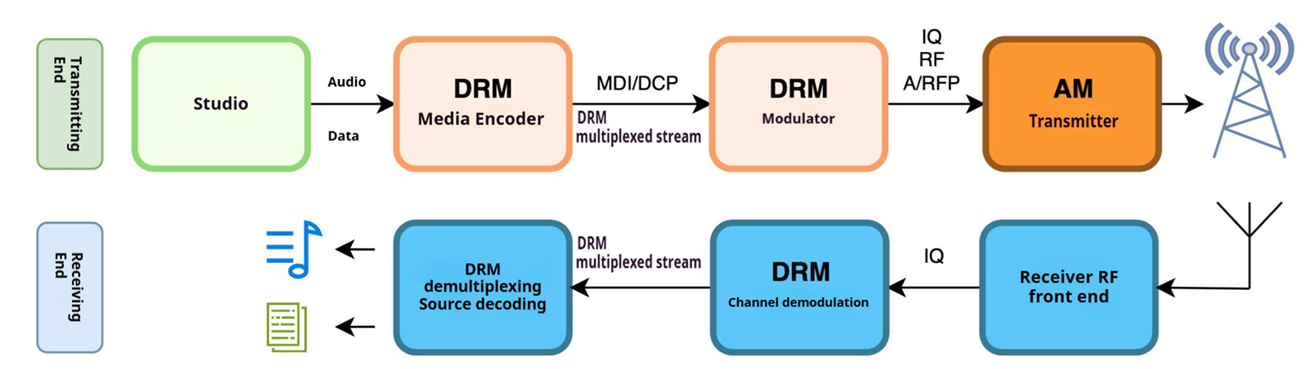
Figure 1. The broadcast and reception workflow of DRM
At present, the DRM standard relies mainly on MPEG-4 HE-AAC and USAC (Unified Speech and Audio Coding). USAC is an international ISO/MPEG audio standard whose official term is MPEG Extended High-Efficiency Advanced Audio Coding; it aims to unify the coding of speech and music while providing, by design, backward compatibility with other AAC-family profiles. HE-AAC uses psychoacoustic models to remove redundant information masked by the human ear, suits scenarios above 8 kbps, handles mixed music and speech in mono and stereo, and delivers a high-fidelity listening experience.
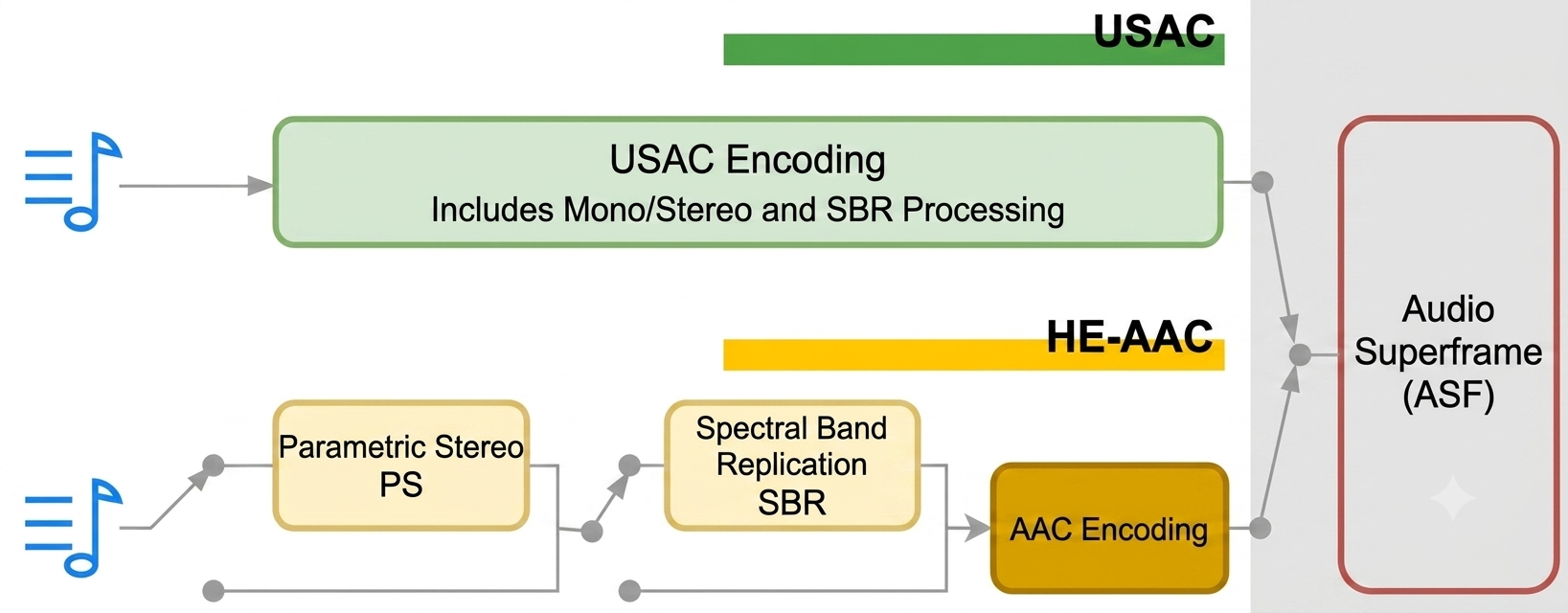
Figure 2. DRM audio coding flow: integration and modular comparison of USAC and HE-AAC
USAC is the most advanced codec in today’s DRM ecosystem, breaking down the boundary between speech and music coding. Based on the characteristics of the input signal, USAC can switch dynamically, frame by frame, between a speech-coding mode and a general audio-coding mode. This means a station no longer needs to manually change encoder settings to play a song within a news program. USAC makes it possible to transmit music and speech at rates as low as 6 kbps, with audio quality far exceeding traditional shortwave broadcasting. This flexible coding choice lets operators dynamically adjust the bit rate to the nature of the program content, maximizing spectral efficiency. USAC is the key to understanding why DRM can replace analog broadcasting — it saves spectrum resources without compromising audio quality.
Especially worth noting is that DRM introduces Spectral Band Replication (SBR) as a key tool for bandwidth extension. In the extremely bandwidth-limited mediumwave and shortwave bands, transmitting full-band, high-fidelity audio is a major challenge. The way SBR works is both ingenious and instructive: it exploits the psychoacoustic properties of the human auditory system. Research has found that the waveform detail of high-frequency sound is not as perceptually critical as that of low frequencies; the ear pays more attention to the envelope and spectral structure of high frequencies. SBR therefore applies high-precision waveform coding only to the low-frequency part of the audio signal, while for the high-frequency part it extracts and transmits only the envelope features and a small amount of auxiliary control information. At the receiver, this auxiliary information is used to “reconstruct” the high-frequency components from the high-quality low-frequency signal through algorithms such as harmonic extension. This approach delivers a broad audio experience even at very low bit rates (for example, with an additional overhead of just 2 kbps), greatly improving the listener’s subjective experience.
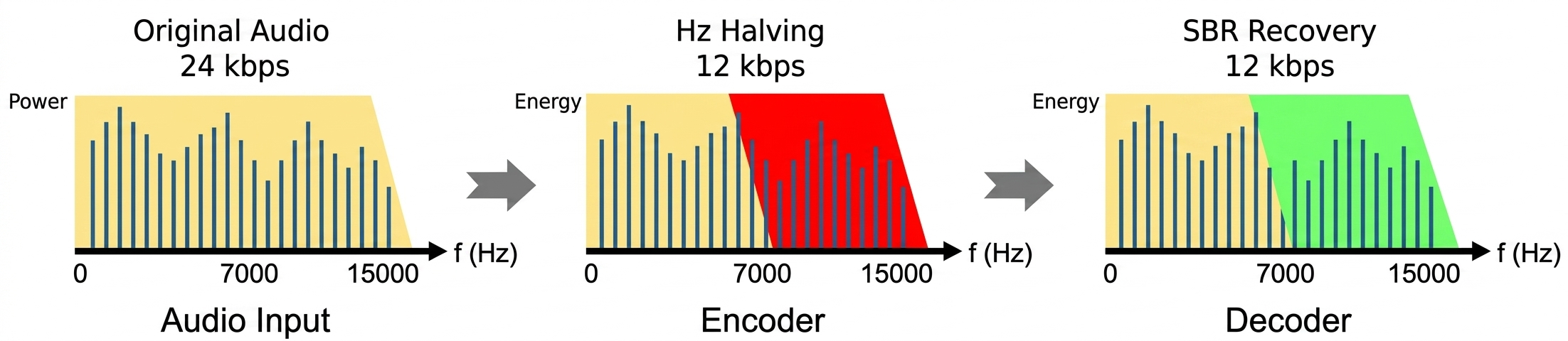
Figure 3. How Spectral Band Replication (SBR) works: audio spectrum compression and high-frequency reconstruction
Newglee’s NGA-101 DRM Media Encoder is the core carrier of exactly this advanced audio-processing capability. The NGA-101 is a professional digital broadcasting system that supports multi-stream, real-time audio encoding in the Unified Speech and Audio Coding (USAC) format. As the principal standard for MPEG Extended High Efficiency AAC, the NGA-101 can efficiently combine audio, DRM text, MOT SlideShow and other services into the DRM multiplex.
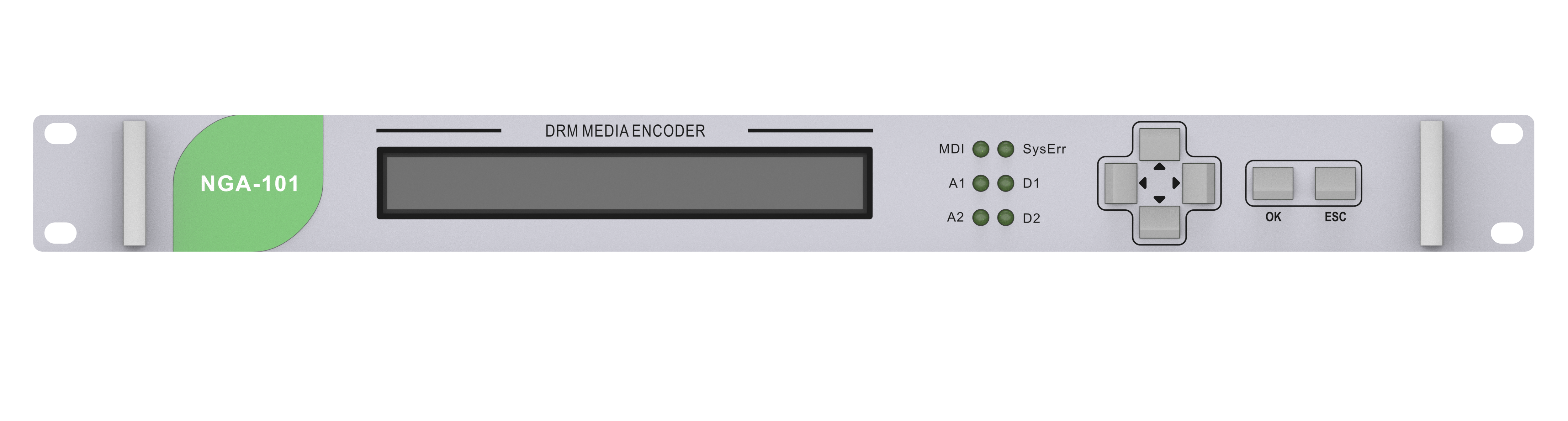
Figure 4. NGA-101 DRM Media Encoder
By strictly following the USAC standard during encoding and combining it with SBR (Spectral Band Replication) and PS (Parametric Stereo), the NGA-101 ensures that even within the limited shortwave and mediumwave bands, the broadcast signal still delivers near-FM-quality, high-fidelity audio — completely transforming the listening quality of traditional AM broadcasting. Whether the program content is varied or the propagation environment is complex, the NGA-101 provides the coding flexibility and quality assurance required, making it the key front-end device for broadcasters to achieve a leap in audio quality.
After source coding, the data stream then enters the multiplexer. The multiplexer is the “dispatch center” of the DRM system, packing audio data, service description information and other multimedia data into a single unified data stream called the DRM multiplex frame. This process ensures the receiver can not only hear the sound but also know what the station is called, what program is playing, and even obtain the current traffic conditions. This tight binding of content and metadata is one of the fundamental features distinguishing digital broadcasting from analog.
The reason DRM signals can be transmitted stably over such highly unstable channels as shortwave and mediumwave lies in its modulation technology — Coded Orthogonal Frequency-Division Multiplexing (COFDM). Traditional digital modulation often uses a single carrier to transmit high-rate data; once that carrier suffers frequency-specific interference or frequency-selective fading, the carrier amplitude drops sharply or even disappears, and the entire link breaks. In shortwave propagation, signals often reach the receiver after multiple reflections off the ionosphere, and this multipath effect causes severe fading and inter-symbol interference.
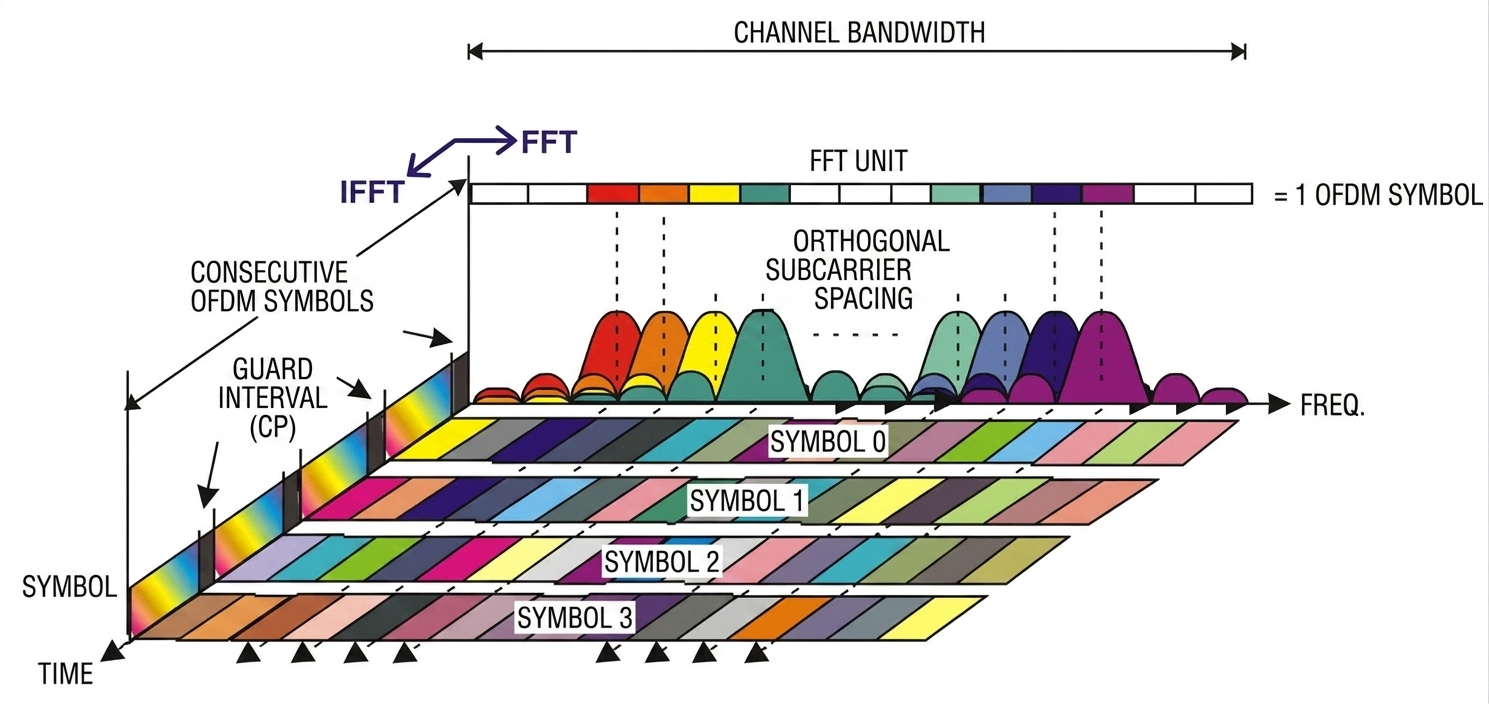
Figure 5. The time-frequency structure of a COFDM signal and its orthogonal subcarriers
COFDM takes a “divide and conquer” approach, spreading the high-speed digital bitstream across hundreds or thousands of parallel subcarriers. Within a 9 kHz or 10 kHz bandwidth, a DRM system distributes roughly 100 to 200 subcarriers. Although each subcarrier transmits data at a very low rate, their combined throughput is remarkable. The elegance of this design is that, by lengthening each symbol’s duration (from 9 ms to as long as 24 ms) and inserting a guard interval, the signal duration is made far greater than the channel’s delay spread. It is like inserting a long enough pause between two rapidly spoken sentences so the listener does not confuse the content because of echoes. Moreover, these subcarriers are arranged orthogonally in frequency, which means that although their spectra overlap, they do not interfere mathematically. The receiver can precisely separate the information on each subcarrier.
To further improve system robustness, DRM also introduces interleaving. In shortwave channels, interference is often bursty and can instantly wipe out a large, contiguous block of data. If that data happens to belong to the same audio frame, the listener hears an obvious pop or dropout. Interleaving scatters originally contiguous data across different time and frequency positions according to specific rules. At the receiver, the data is reordered into its original sequence. In this way, burst errors that originally occurred all at once are spread over a long span of time, becoming sparse, random errors. Combined with powerful channel error-correction coding, the receiver can easily repair these sparse errors, achieving a “lossless” listening experience. This organic combination of source coding, channel coding, interleaving and COFDM modulation forms the unshakable technical foundation of the DRM system.
The Fine Structure of the DRM Multiplex Frame and How the System Operates
The DRM system is not merely a pipe for transmitting audio; it is more like a highly organized digital container-shipping system. To ensure different types of data (audio, text, control instructions) reach the receiver in an orderly and efficient way, DRM defines a rigorous multiplex frame structure. Understanding this structure is key to mastering DRM service configuration and flexible scheduling. For system integrators, it is also the basis for designing transmitter exciters and receiver demodulation algorithms.
The basic time unit of DRM transmission is the “transmission super frame.” Each super frame has a fixed duration of 1.2 seconds — a length chosen not arbitrarily, but as the optimal solution after considering audio frame length, channel interleaving depth and receiver synchronization speed together. This 1.2-second container is further divided into three transmission frames of 400 ms each. Within this time container flow three parallel logical channels, each with its own role, together keeping the broadcast service running. They are the Main Service Channel (MSC), the Fast Access Channel (FAC) and the Service Description Channel (SDC).
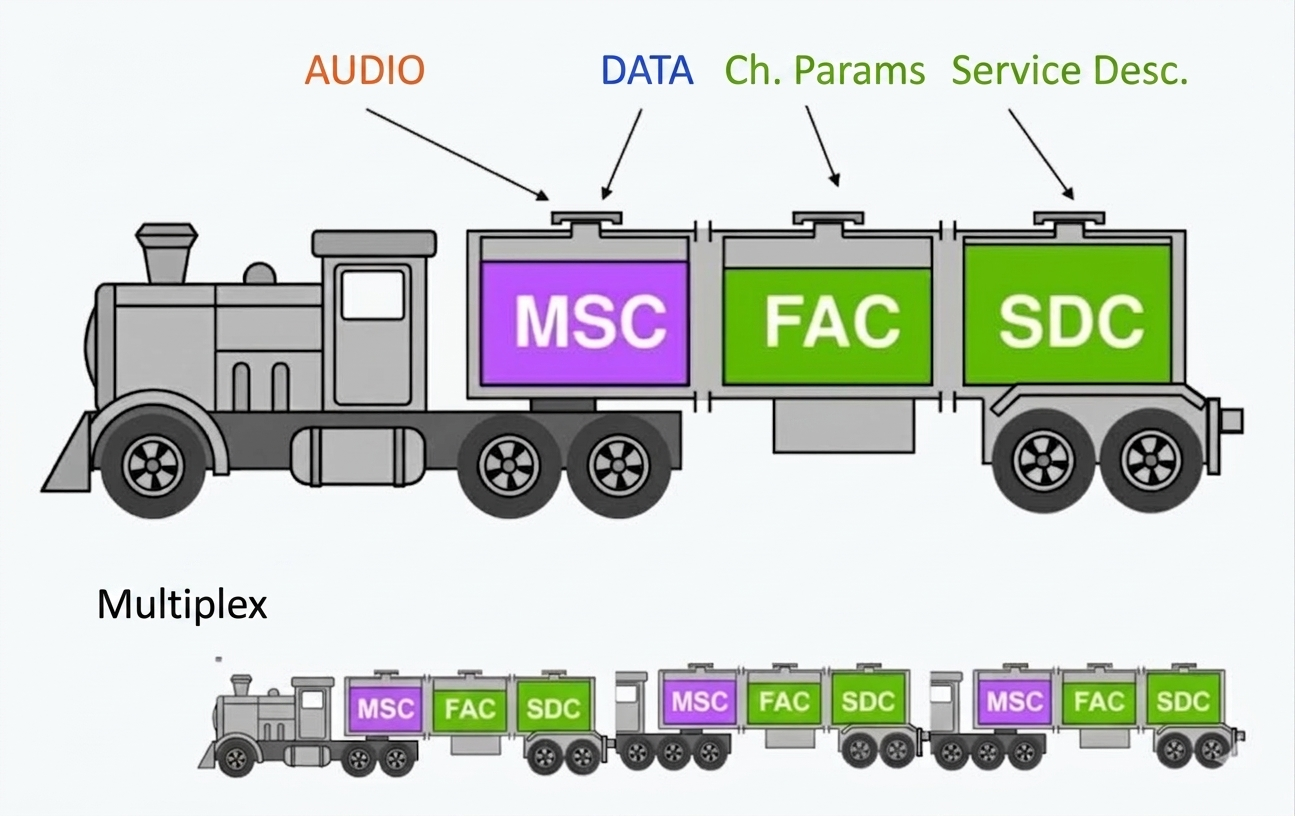
Figure 6. The DRM multiplex structure: FAC, SDC and MSC data frames
The Main Service Channel occupies the most bandwidth in the DRM multiplex frame and carries the core content. We can think of it as the main compartment of a freight truck, loaded with the content listeners really care about — audio streams and data streams. The MSC is extremely flexible, capable of carrying up to four independent service streams simultaneously. These streams can be pure audio, pure data, or a combination of both. Each audio stream contains not only compressed audio data but can also carry a small amount of text (such as a scrolling song title or news brief). Data streams, meanwhile, are an important feature distinguishing DRM from analog broadcasting. In particular, when DRM’s packet mode is used, a single physical data stream can be further divided into up to four “sub-streams.” This means that within one data pipe, four different data services can be transmitted in parallel — for example, one carrying traffic information and another carrying electronic map updates, without interfering with each other.
If the MSC is the fully loaded cargo compartment, then the Fast Access Channel (FAC) is the dispatch signal light on the cab. Although the FAC carries very little data, it is critically important. Its main task is to tell the receiver: What is this signal? Which services does it contain? How should it be demodulated? The information in the FAC falls into two categories: first, channel parameters that describe the physical properties of the signal, such as spectrum occupancy (9 kHz or 10 kHz bandwidth?), the modulation scheme (16QAM or 64QAM?), and the total number of service streams in the multiplex; second, service parameters that give the receiver the ability to quickly scan and identify services, such as each service’s unique identifier and language code. Because the FAC carries the most basic system information, it uses the most robust transmission parameters, ensuring that even in very poor signal conditions the receiver can first lock onto the FAC and thereby learn the basic state of the system.
Once the receiver “discovers” a signal through the FAC, it needs more detailed information to present the content correctly — and that is the role of the Service Description Channel (SDC). The SDC can be seen as a detailed “user manual” or “program guide” sent along with the signal. Unlike the FAC, which is sent every frame, SDC information is sent only once per super frame (1.2 seconds). It carries a large and varied amount of information organized into different “entities.” There are currently 13 defined SDC entity types, covering all kinds of information: from decoding guidance (telling the receiver exactly which audio codec and sample rate a given MSC stream uses), to service linking (describing which streams belong to the same station — for example, an audio stream might be bound to an image data stream), to auxiliary functions (providing time-calibration information, country codes, program-type labels and so on). Especially noteworthy is that the SDC also provides Alternative Frequency information, which is crucial for mobile reception, letting the radio automatically switch to a better frequency as the signal weakens — a seamless roaming experience similar to a cellular network.
| Channel | Full Name | Analogy | Main Content | Transmission Frequency |
|---|---|---|---|---|
| MSC | Main Service Channel | Cargo compartment | Audio data, multimedia data, text | Continuous |
| FAC | Fast Access Channel | Dispatch signal light | Bandwidth mode, modulation parameters, service ID | Every frame (400 ms) |
| SDC | Service Description Channel | User manual | Decoding parameters, multilingual labels, alternative frequency list, time information | Every super frame (1.2 s) |
This three-channel design reflects the DRM system’s wisdom in balancing efficiency and reliability. The MSC pursues maximum throughput using higher-order modulation; the FAC pursues maximum robustness using lower-order modulation and strong error correction; the SDC sits between the two, handling complex metadata management. For operators, this means the coverage and audio quality can be balanced by adjusting the MSC’s protection level, without worrying about losing the system’s basic bootstrap information. This structure also leaves room for future expansion: new service types can be defined by adding new SDC entities without breaking the existing receiver architecture.
From “Listening to Radio” to “Using Radio”: Developing Multimedia Services
The appeal of DRM lies not only in “hearing clearly,” but also in “seeing” and “using.” Through the Main Service Channel, DRM provides a complete data-transmission mechanism, so that broadcasting is no longer limited to sound but evolves into a multimedia information service. For broadcasters, this means a fundamental shift in business model: from a single audio content provider to a comprehensive information-service distributor.
To accommodate different types of data applications, DRM defines three data-transmission schemes that operators can choose flexibly according to their needs. The first is the synchronous data stream, a transmission method akin to a transparent pipe. Data is fed in continuously at a fixed bit rate, and flows out at the receiver at the same rate. This suits applications with extremely high real-time requirements and a constant data-generation rate. However, it requires the content provider to guarantee the continuity of the data stream — any interruption leaves the pipe idle, wasting precious bandwidth. The second is DRM packet mode, the most commonly used and most flexible mode. Similar to internet IP-packet transmission, data is divided into packets of finite length. This mode supports asynchronous transmission — send when there is data, stop when there is none — greatly improving bandwidth utilization. More importantly, it allows multiple sub-services to be multiplexed within the same MSC data stream, with the system dynamically allocating bandwidth based on data volume. The third is the asynchronous data stream, a special application based on packet mode that offers a compromise between the first two.
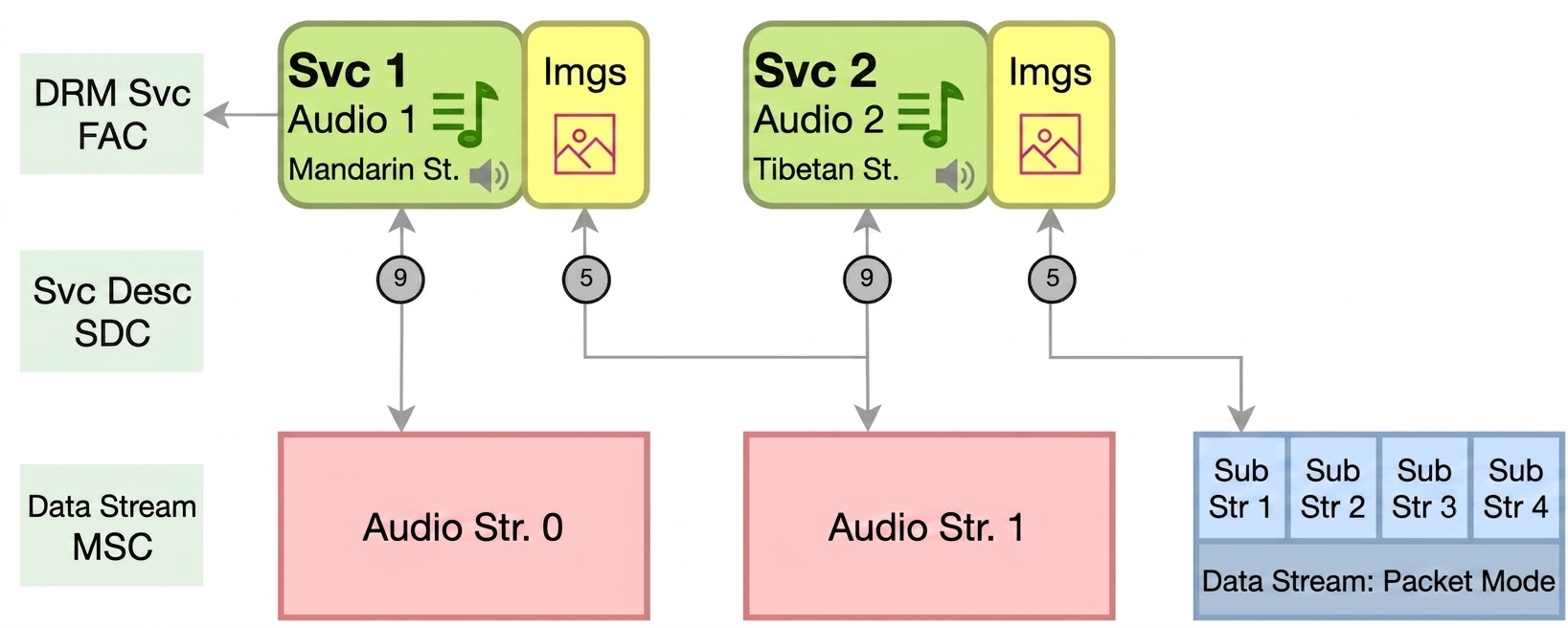
Figure 7. DRM multi-service multiplexing architecture and shared data streams
On top of these transmission mechanisms, DRM builds a set of standardized applications that greatly enrich the meaning of broadcasting. The most representative is SlideShow. Through DRM, a station can send JPEG or PNG images in sync with the audio — displaying album art while playing music, showing on-scene photos during news, or pushing real-time traffic maps during traffic broadcasts. This gives radio visual impact, making it far more appealing in competition with in-car screens, phones and other terminals. In addition, DRM supports the Broadcast Website and the Electronic Program Guide (EPG). The former transmits pages in HTML format, giving users an experience on the receiver similar to browsing a local website; the latter lets users view the program schedule for the coming days and set reminders. Together, these features form a rich and colorful digital broadcasting ecosystem, completely transforming the traditional radio habit of “listen now or miss it, and by ear only.”
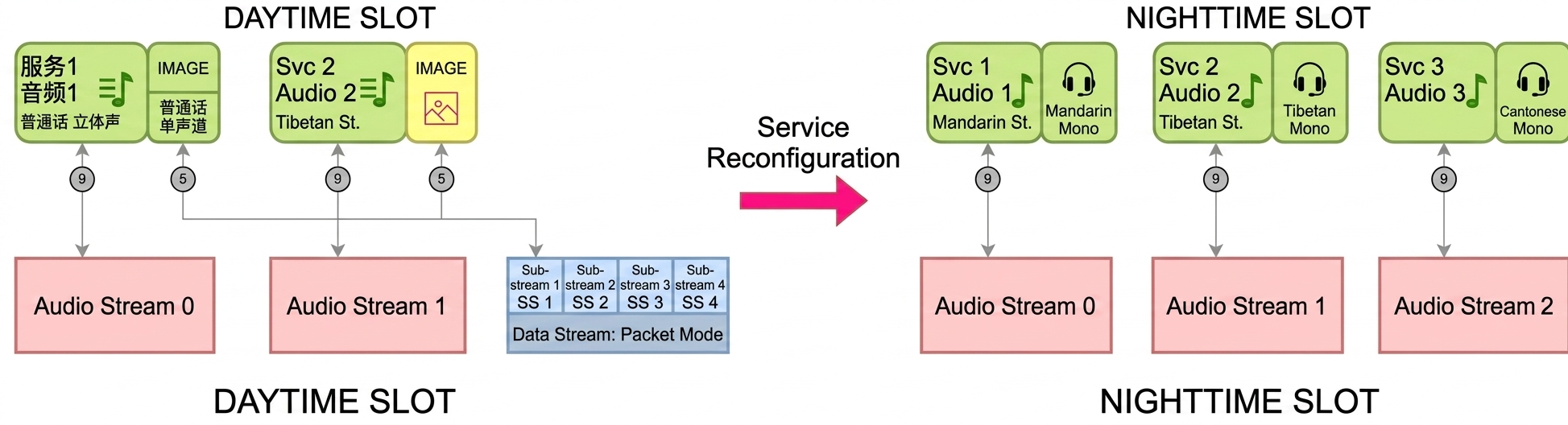
Figure 8. DRM dynamic service reconfiguration and multi-period resource optimization
Further still, DRM supports dynamic reconfiguration, which lets operators schedule resources flexibly. In the analog era, one frequency meant one program, and resources were fixed. In DRM, through SDC configuration, operators can do countless things. For example, an operator can offer two audio programs within the same multiplex. Although the two programs play different languages (such as Mandarin and Tibetan news), they can share the same image data stream — a “sharing” mechanism that maximizes the use of limited bandwidth. Alternatively, operators can dynamically adjust the service configuration by time of day. For instance, during the day, when ground-wave propagation is stable, they might configure two high-fidelity stereo music stations carrying news images; in the evening, as ionospheric reflection strengthens and interference grows — or to relay top-of-the-hour news — the operator can instantly switch the configuration to three mono speech stations and increase the strength of error-correction coding to ensure reliable reception. This switching is transparent to the user: the receiver automatically adapts to the new configuration, ensuring a continuous listening experience. This capability gives operators unprecedented operational flexibility, letting them optimize their broadcast strategy in real time according to audience needs and channel conditions.
Figure 9. NGA-101 DRM Media Encoder
At the heart of this operational flexibility and multi-service convergence is Newglee’s NGA-101 DRM Media Encoder. The NGA-101 not only supports USAC and HE-AAC HD audio coding, but is also a powerful information-aggregation hub, able to combine rich multimedia services — audio, DRM text, MOT SlideShow and interactive data — into a single, complete DRM multiplex.
It supports flexible arrangement of multiple multiplex configurations, perfectly matching operators’ need to schedule resources dynamically by time period and propagation conditions. The NGA-101 is compatible with all DRM30 robustness modes and protection ratios, ensuring high delivery rates in complex environments. Notably, when outputting the standard MDI/DCP multiplex stream, the NGA-101 integrates PFT (Protection, Fragmentation and Transport), applying error protection to the IP stream and greatly enhancing transmission reliability — providing solid front-end technical support for broadcasters transforming into comprehensive information-service distributors.
The Economics of Green Broadcasting: Efficiency, Coverage and Infrastructure Reuse
In today’s global energy landscape, the energy efficiency of broadcasting systems has become a key metric for broadcasters. Traditional analog AM broadcasting, though advantageous in coverage, is undeniably very inefficient in its use of energy. In the frequency domain, an AM signal consists of a central carrier component and two symmetrical sidebands (the upper sideband, USB, and the lower sideband, LSB). The distribution of RF energy directly determines the transmission efficiency of the system.
-
Carrier: Whether modulated or not, the carrier component is always present and occupies the vast majority of the total transmit power. Yet from an information-theory perspective, the carrier is a deterministic sine wave with zero entropy — that is, the carrier itself carries no audio information. Its sole engineering purpose is to provide phase and frequency reference for early non-coherent demodulation receivers (such as envelope detectors), allowing the receiver to recover the signal at very low cost (just a diode and a capacitor).
-
Sidebands: The real audio information is contained entirely in the two sidebands. The amplitude of the sidebands varies with the audio signal, carrying the effective information entropy.
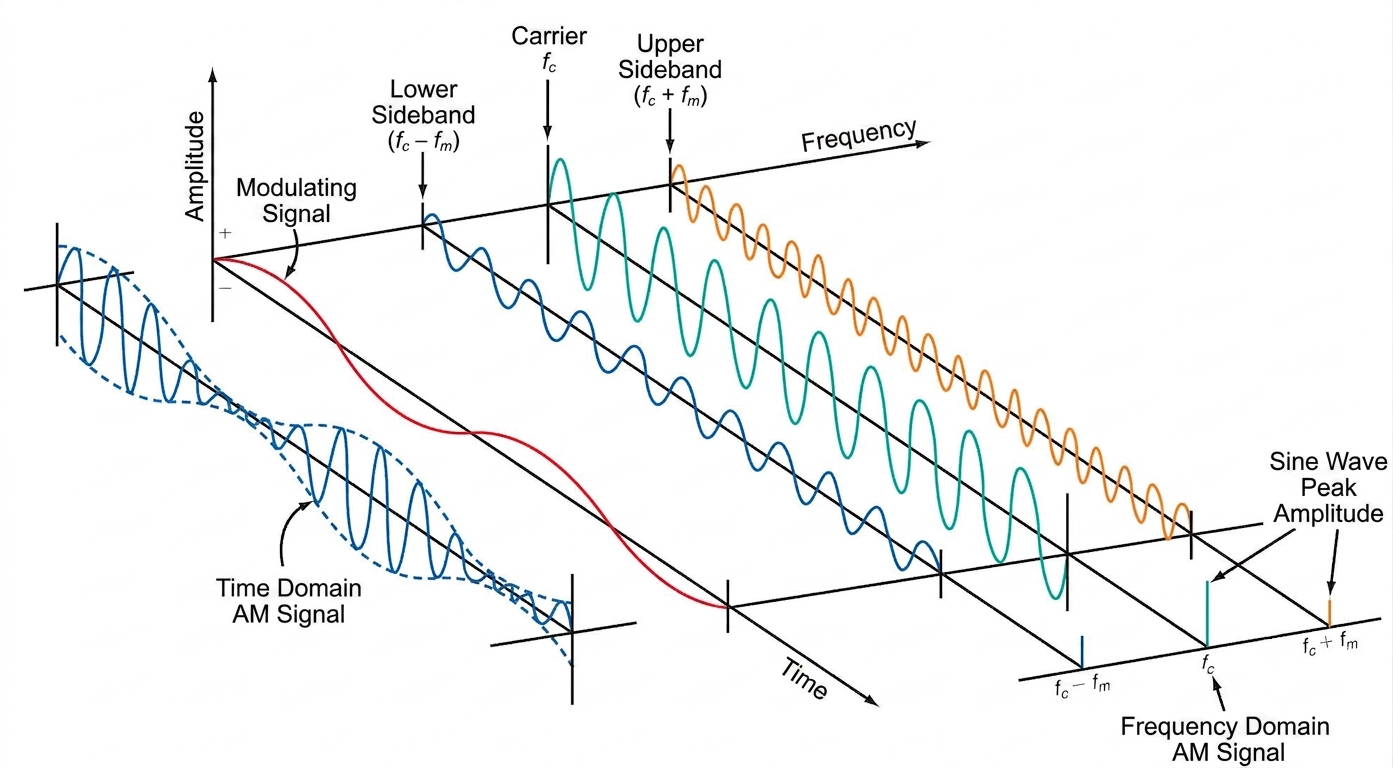
Figure 10. Time-domain and frequency-domain decomposition of an analog AM signal
To convey information, the AM transmitter must always transmit the carrier at high power, even during silence. This means a large amount of electrical energy is used merely to “assist” cheap receivers, ultimately dissipated as heat, with only a small fraction actually carrying audio information. By contrast, as a digital system, DRM devotes its transmit power mainly to carrying useful bits, showing an overwhelming efficiency advantage — earning it a reputation as a model of “green broadcasting.”
In the frequency domain, a DRM signal no longer takes the form of a “tall central tower with low slopes on either side,” but instead presents a nearly rectangular, flat power spectrum. The DRM system does not need to transmit a high-power carrier to assist demodulation. The receiver uses coherent demodulation, performing channel estimation and synchronization with low-power pilots scattered among the data symbols. This allows the vast majority of the transmitter’s energy to go directly to the data-carrying subcarriers. A DRM signal consists of hundreds or thousands of narrowband subcarriers (the exact number depends on bandwidth and mode; Mode A in a 10 kHz bandwidth has about 200). Each subcarrier is independently modulated with quadrature amplitude modulation (QAM). Because the non-informational carrier is removed, almost all of the DRM transmitter’s average power is used to carry useful bits. This is the key reason DRM can achieve equal coverage at a fraction of the power.
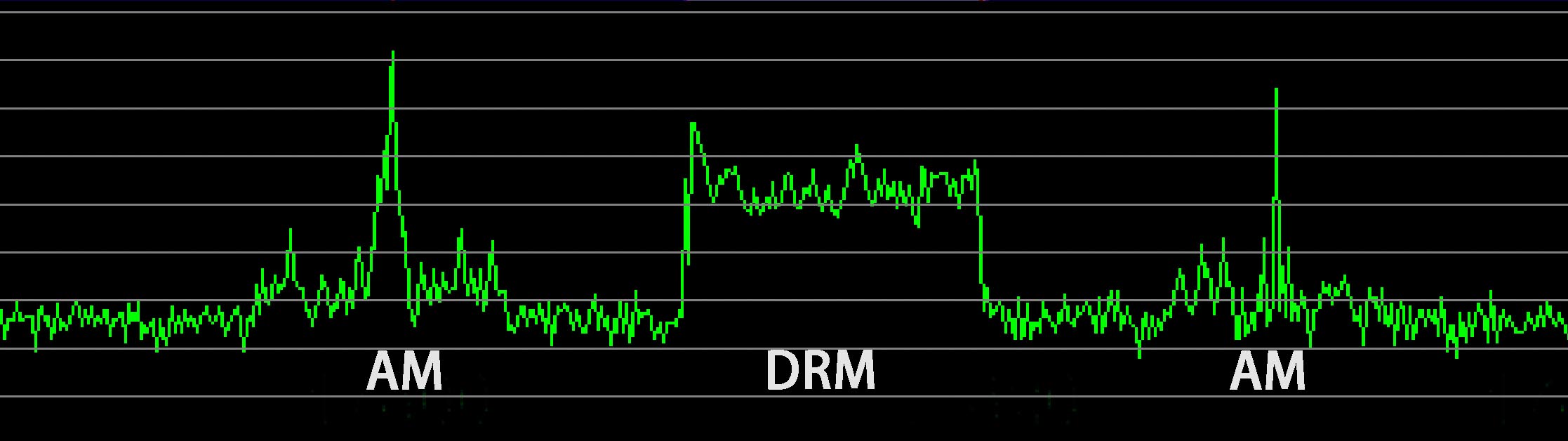
Figure 11. Spectrum comparison of AM and DRM signals: the carrier-free advantage of digital broadcasting
Engineering practice and field-test data show that, to achieve the same effective coverage and a better-than-analog signal-to-noise ratio, a DRM system requires an average radiated power of only 20% to 25% of analog AM. This finding, known as the “quarter-power rule,” is a core pillar of the economic case for DRM.
To quantify the energy savings, let us build a detailed annual energy-consumption model. Assume both transmitters run under a typical broadcast station duty cycle (24 hours/365 days). In terms of overall efficiency, even a fairly advanced solid-state analog AM transmitter typically has an AC-to-RF efficiency of around 70%–75% (75% used here), while a modern DRM transmitter, thanks to high-efficiency power-amplifier technology, has been optimized to an average efficiency of 85%–90% (85% used here). Based on these parameters, we quantify their power consumption:
| Parameter | 250 kW Analog AM Transmitter | 80 kW DRM Transmitter | Difference (Savings) |
|---|---|---|---|
| RF output power | 250 kW (carrier + sidebands) | 80 kW (all-information power) | -170 kW |
| Overall AC-RF efficiency | ~75% | ~85% | +10% |
| Grid input power | 250 ÷ 0.75 ≈ 333.3 kW | 80 ÷ 0.85 ≈ 94.1 kW | -239.2 kW |
| Annual operating hours | 8,760 hours | 8,760 hours | 0 |
| Total annual energy use | 2,919,708 kWh | 824,316 kWh | 2,095,392 kWh |
The analysis shows that, for a single transmitter alone, the DRM solution saves over 2.09 million kWh of electricity per year; the system consumes only 28% of the energy of an analog system with equivalent coverage — an energy saving of up to 72%.
This structural energy advantage translates directly into a substantial reduction in operating costs. At an industrial electricity price of RMB 0.8/kWh, the DRM solution saves about RMB 1.677 million per year in electricity costs per unit. For broadcasters with large transmitter networks, this reduction is structural and can greatly improve financial health.
Moreover, the efficiency gain significantly reduces the heat load of the equipment room. A 250 kW AM transmitter (333 kW input) generates about 83 kW of waste heat, while an 80 kW DRM transmitter (94 kW input) generates only 14 kW. The heat load drops by 83%, greatly reducing reliance on large air-conditioning systems, further improving energy-use efficiency and lowering infrastructure costs. Finally, under “dual-carbon” goals, the environmental benefit is also crucial. Based on internationally accepted carbon-emission factors, replacing a single 250 kW AM transmitter with an 80 kW DRM unit can cut about 1,047 tonnes of CO₂ emissions per year. This makes DRM a key technical path for the broadcasting industry to fulfill its social responsibility and respond to climate policy.
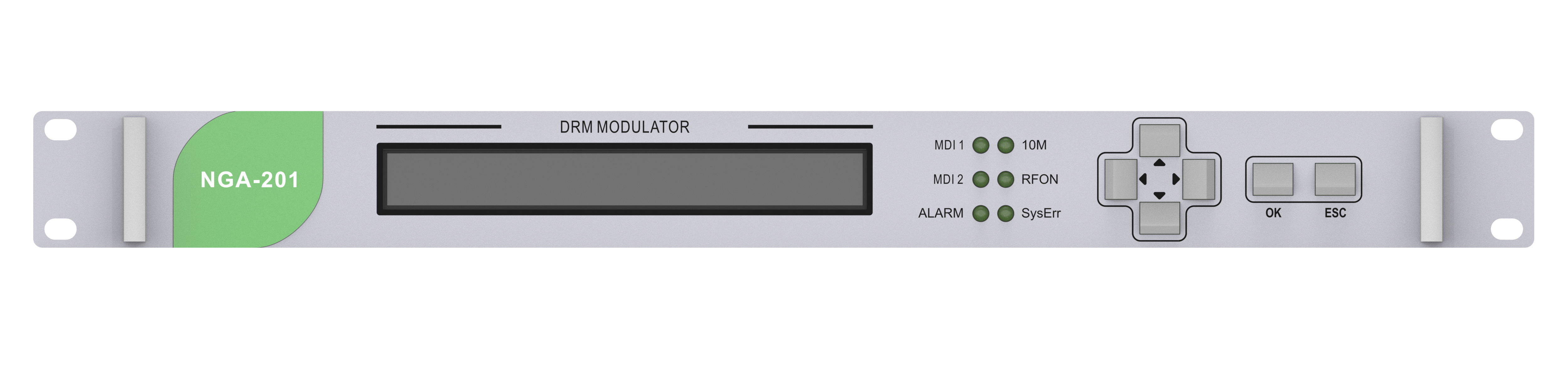
Figure 12. NGA-201 DRM Modulator
Newglee’s NGA-201 DRM Modulator integrates digital predistortion (DPD), adaptive linear and non-linear precorrection, and PAPR (peak-to-average power ratio) reduction, significantly improving system performance and transmission efficiency and helping operators achieve cost-optimization goals.
Beyond saving power, DRM also greatly conserves precious spectrum resources. In the VHF band, traditional analog FM stereo broadcasting typically needs about 200 kHz of bandwidth to guarantee audio quality. In the VHF band (Mode E), DRM needs less than half the bandwidth of FM (96 kHz) to transmit as many as three audio programs plus rich data services. This effectively increases the commercial value of the spectrum more than sixfold (from 1 program/200 kHz to 3 programs/100 kHz). This gain in spectral efficiency is especially important in urban environments where spectrum is increasingly scarce, allowing operators to deploy more stations within limited bands via single-frequency networks (SFN), offer more diverse content, and gain an edge in fierce media competition.
In terms of coverage, DRM uses COFDM to effectively overcome multipath fading. In analog shortwave broadcasting, listeners often experience signals that fade in and out, accompanied by severe phase distortion and noise — the classic symptom of multipath fading. DRM, by contrast, delivers clear sound with a lower reception threshold. This means that at the same transmit power, a DRM signal can be successfully demodulated by receivers at greater distances, effectively extending the useful coverage radius. Furthermore, DRM applies not only to the traditional AM bands (longwave, mediumwave, shortwave) but also extends into the VHF band, complementing other digital standards such as DAB+ to form a full-band digital coverage network.
For system integrators, one great advantage of DRM is its high reusability of existing infrastructure. Moving from analog to digital does not mean tearing down and rebuilding existing towers, antennas and transmitter rooms. The DRM standard was designed with this in mind from the outset. Many modern analog AM transmitters need only an exciter upgrade and linearization of the final-stage amplifier to support DRM transmission. Expensive heavy assets such as the antenna system and towers can usually be reused directly. In addition, DRM supports simulcast mode, allowing operators to transmit the digital signal alongside an existing analog channel, using an idle half-channel bandwidth, or on an adjacent frequency. This smooth-transition approach lets operators gradually cultivate a digital audience without losing existing analog listeners, ultimately achieving a full digital switchover.
Strategic High Ground and Future Outlook: Emergency Broadcasting and the Industry Ecosystem
In the macro strategic map of China’s broadcasting industry, DRM is not merely an upgrade of broadcasting technology but an important part of the national emergency communication system. When major natural disasters such as earthquakes and floods strike, fiber networks may break, base stations may collapse, and power may be cut — modern communication networks often fail instantly. Mediumwave and shortwave broadcasting, thanks to the physical properties of ground-wave diffraction and sky-wave reflection, often become the last line of information defense left standing — a key channel for the government to issue instructions to disaster-stricken populations and reassure the public.
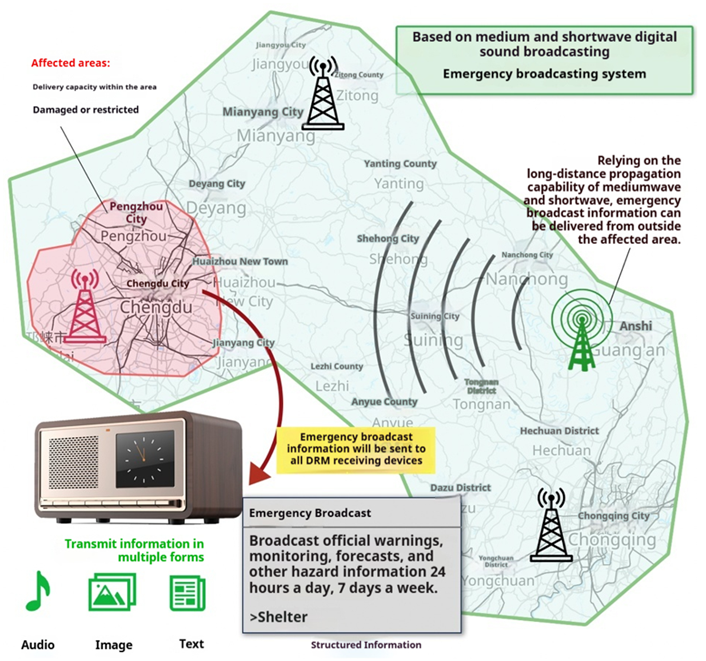
Figure 13. Coverage of a DRM emergency broadcasting system based on long-distance mediumwave/shortwave propagation
DRM’s unique EWF (Emergency Warning Functionality) makes it an ideal next-generation emergency broadcasting platform. Unlike traditional analog broadcasting, which can only passively wait for listeners to tune in, the DRM system can send special control instructions. When a disaster occurs, the transmitter can trigger the EWF signal to forcibly wake DRM receivers from standby and automatically switch them to the emergency channel. Even more powerfully, DRM can not only play voice alerts but also display, on screen, detailed information such as multilingual evacuation guides and shelter maps. This capability — combining text and images, forced wake-up and multilingual support — greatly improves the accuracy and efficiency of information delivery. For broadcasters with a public-service mandate, deploying DRM is not just a technical upgrade but a necessary measure to fulfill social responsibility and strengthen national emergency preparedness.
Newglee’s DRM emergency broadcasting solution is a complete, end-to-end, seamlessly connected system designed to link China’s emergency broadcasting platform with the DRM digital broadcasting network efficiently and precisely.
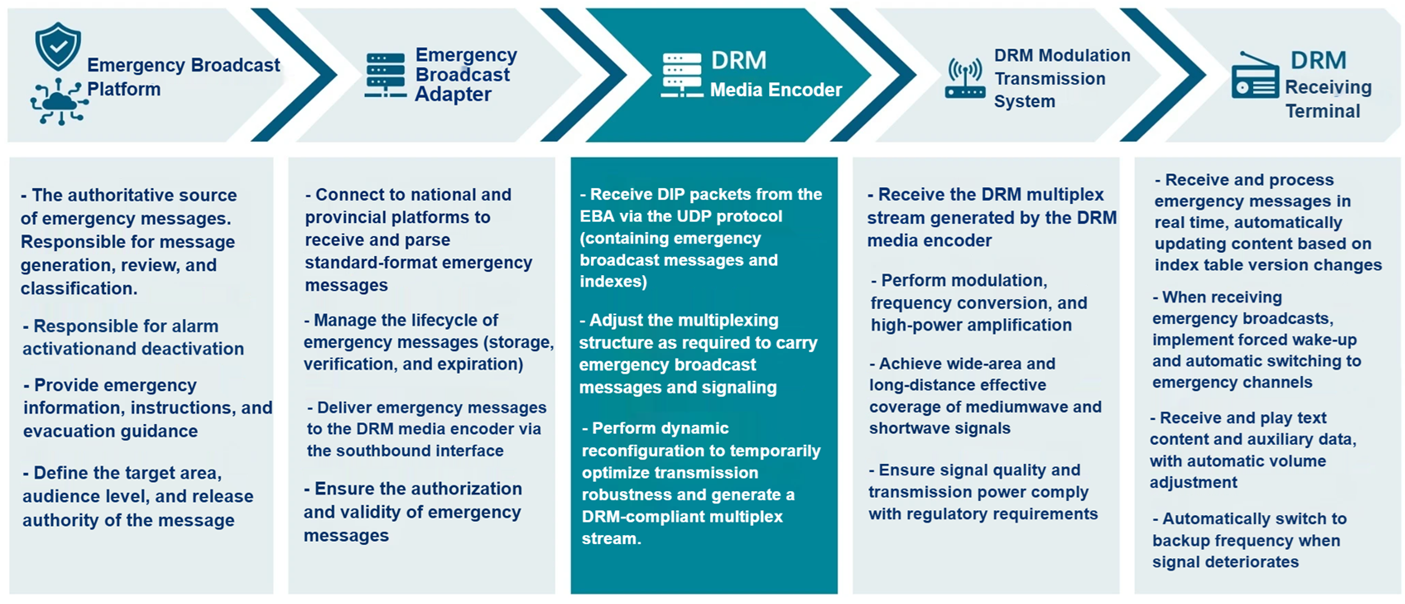
Figure 14. End-to-end system architecture and functional workflow of the DRM emergency broadcasting solution
This solution is an end-to-end system connecting the emergency broadcasting platform with the DRM network, composed of five major components. The Emergency Broadcast Adapter (EBA) acts as the core bridge, receiving and parsing emergency broadcast messages issued by the emergency broadcasting platform. The DRM Media Encoder (DME) then receives the EBA’s DIP packets, performs encoding and multiplexing, executes dynamic reconfiguration, and generates the multiplex stream. The signal achieves wide-area coverage through the DRM modulation and transmission system. Finally, DRM receivers perform signaling monitoring, forced wake-up, automatic frequency switching and precise display of multimedia information, ensuring the reliable delivery of emergency information.
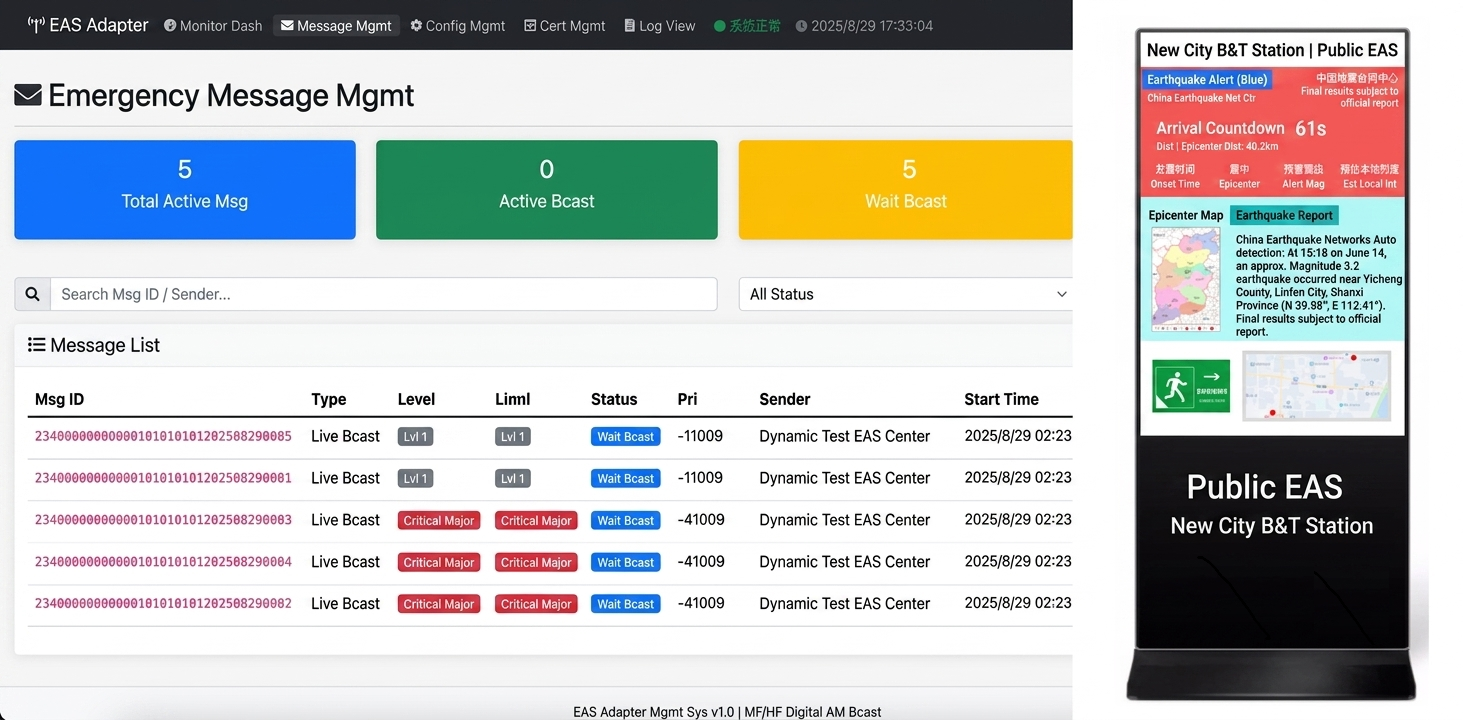
Figure 15. The Newglee DRM Emergency Broadcast Adapter message-management interface and an outdoor information display screen
Looking ahead, as standards such as the “Technical Specifications for Mediumwave and Shortwave Digital Radio Broadcasting” are implemented, China’s DRM industry will enter a period of rapid growth. For broadcasters, we recommend actively piloting single-frequency network deployments, using DRM’s support for co-channel coverage to solve gap-filling coverage in key areas; at the same time, do not view DRM merely as a replacement for audio broadcasting, but as a “wireless data distribution network,” actively developing packet-mode industry applications — such as remote data-push services for specific sectors like deep-sea fisheries and geological surveying — to open up new revenue models. For system integrators, seize the opportunities in transmitter upgrades and multi-mode receiver development to drive the adoption of DRM in in-vehicle terminals and consumer electronics. In particular, in the new-energy-vehicle sector, DRM’s high audio quality, low power consumption and data services align closely with the concept of the smart cockpit — a huge potential market.
The maturation and standardization of Digital Radio Mondiale (DRM) technology has breathed new life into the venerable AM band. It is no longer the old, static-filled radio, but an efficient, green, intelligent multimedia information platform. Through precise digital signal processing, a flexible multiplexing architecture and powerful interference resistance, DRM has successfully achieved a dual leap in both audio quality and service within limited bandwidth. For the broadcasting industry, this is a historic opportunity to transform from a “radio station” into a “comprehensive information service provider.” By embracing DRM, we can not only substantially reduce operating costs and answer the nation’s call for energy conservation and emission reduction, but also, through rich data services, recapture audience attention in the digital age. As technology continues to evolve and the industry chain matures, a clear, colorful and ubiquitous new era of digital broadcasting is coming our way.
Related Resources: